USA 2-0 Australia: OpenScore Turns One Match Into Three Winning Reads
On June 19 in North America, the United States beat Australia 2-0 in Seattle in the second round of Group D. For most fans, it was the night the host nation moved into the World Cup knockout round. For OpenScore users, it was also a clean validation of the pre-match read: the main direction, the first-half script and the defensive angle all landed inside 90 minutes.

The result: two first-half blows
According to U.S. Soccer’s official recap, both U.S. goals came before halftime. In the 11th minute, Folarin Balogun drove down the left and forced pressure that ended with Australia defender Cameron Burgess bundling the ball into his own net. In the 43rd minute, Alex Freeman reacted first after a set-piece scramble and headed in the second goal. AP later reported that the United States had reached the knockout round after its second straight win.
The important part was not simply that the U.S. won. It was how the game followed the expected script: early pressure, first-half control, then a second half managed through possession, defensive discipline and lower risk.
Why this was “one match, three reads”
OpenScore does not reduce a match to a single yes-or-no pick. The stronger pre-match content breaks a game into several actionable angles. USA 2-0 Australia produced three clear reads:
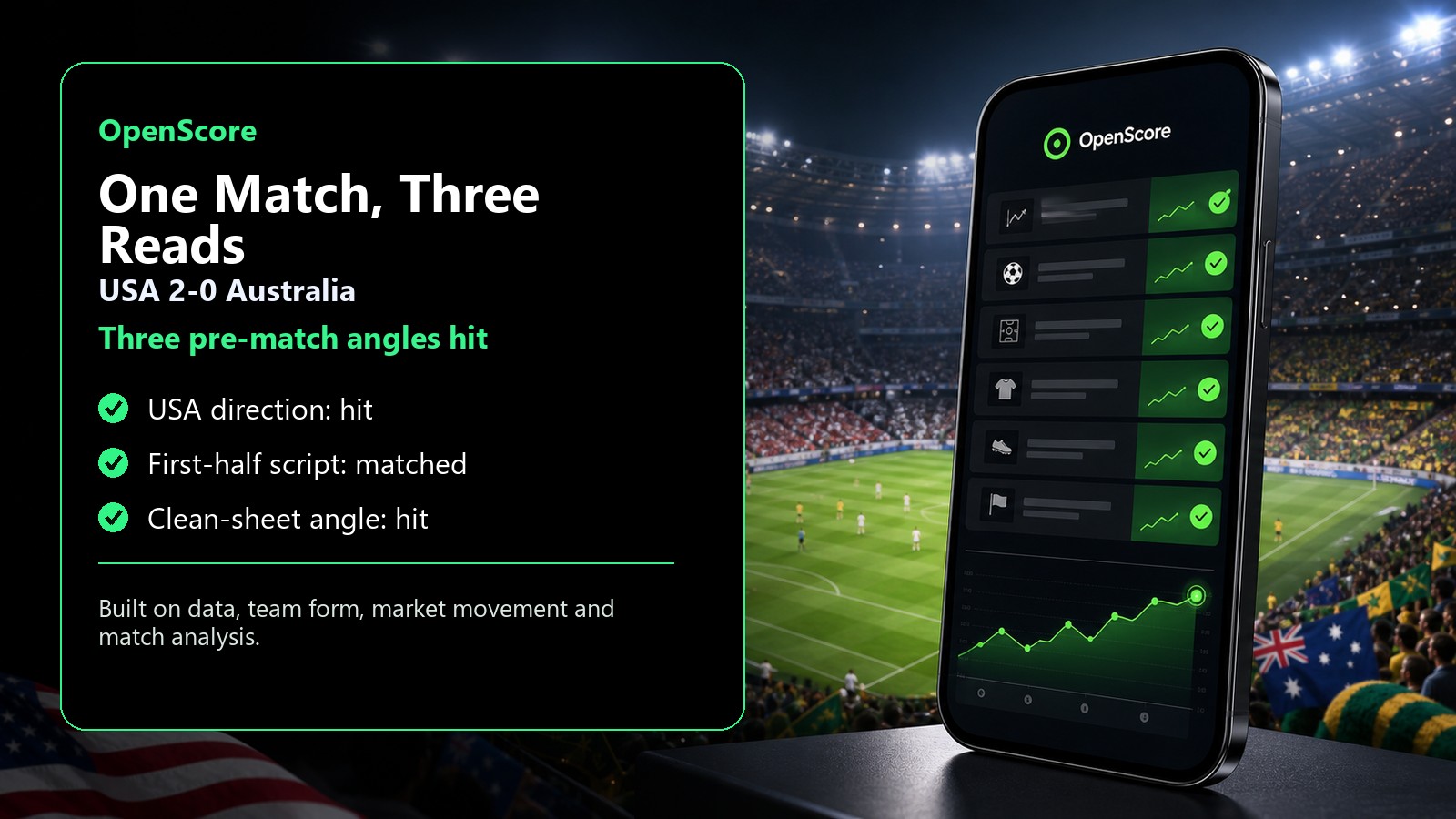
- Read one: USA direction.Home advantage, squad depth and front-line pressure all pointed toward the U.S. side, and the final result stayed on that line.
- Read two: first-half script.The U.S. scored twice before the break, matching the idea that the host could build the match from early intensity.
- Read three: Australia attack limited.Australia needed to push after halftime, but the quality of chances never consistently matched the urgency. The clean sheet confirmed the defensive angle.
The hit was the script, not just the score
The local match report logged the U.S. with 63% possession and advantages in shots, shots on target and corners. The 2-0 scoreline mattered, but the deeper value was that the game never broke away from the pre-match logic: the U.S. controlled the ball, Australia chased, and the higher-quality pressure stayed with the host.
That is the OpenScore method: successful predictions are not built after the match, and they are not built on emotion. They come from data, team form, lineup information, market movement and match analysis before kickoff. When the result arrives, users can see how the pre-match reasoning mapped onto the pitch.

From a 10-for-10 World Cup start to another three-angle hit
Across the first five World Cup days, OpenScore’s key directions produced 10 selections and 10 winners. Expert analyst Hong Kong Tipster has also been highlighted by the platform for hitting 32 of his last 34 matches and going 10-for-10 in the World Cup phase. USA vs Australia did not need a miracle call. Its value was stability: matchup, tempo and defensive outcome were all readable before kickoff.
Inside the OpenScore app, fans can follow expert opinions and Premium Picks. If a Premium Pick is wrong, coins are automatically refunded after the match. In a World Cup schedule full of daily fixtures and surprise results, finding the right direction before kickoff matters more than explaining it after the final whistle.
Ready for the next match? Open OpenScore, check the data, compare the experts and build your pre-match view.
This article is for match analysis and product content only. It is not betting advice.
Sources: U.S. Soccer and AP News.